As we have previously discussed, edginess is a fine line to walk for TV show producers and networks. Not only are you risking societal backlash from parent organizations and anti-violence and/or lude behavior groups, but they run the traditional risk of not garnering a loyal and devoted audience. This loyal and devoted audience will not just keep the shows on air, but will support the series into perpetuity through DVD sales. Yet, the recent activity at the Gateway
Film Center in Columbus, OH would suggest that this model is thrown out the window as they offer screenings of Mad Men and The Killing on the silver screen. Now, you may ask yourself, has AMC gone nuts?
When analyzed through Havens & Lotz's model of media mandates, conditions, and practices, it does not appear so. Why? Well, the conditions in which these types of shows operate require a esteemed critical acclaim as it denotes a certain cache for audiences members to attain for their own through watching the program. Moreover, the practices of watching television are now so scewed towards an individual sitting in their bed watching a show on their laptop, it seems appropriate that AMC would offer up the rights to Gateway in order to create a shared experience within the community of these loyal fans. It may not show up on the Nielsen ratings, but it will show up in merchandising if viewers ascribe an even greater positive experience to watching the show on their own. From the theaters perspective, this is another opportunity for them to make sales on the "20 beers on draft, cocktails, drink specials" while providing free admission for content they did not have to purchase at the same price of a feature film (Gateway Film Center). When you consider the upfront and sunk cost of financing an exhibition venue requires owners to create marketing campaigns that drive greater volume of patrons into their venue at times they normally wouldn't come to a theater and also purchase concessions that support this exhibition process. The overall implications of this unusual practice by a commercially driven industry is to, not suprisingly, make commercial gains through less explicit means. It looks to tap into a pool of forward-thinking patrons that normally frequent the film center for edgy films and creates synergy in this demand by providing edgy television content at the same kind of venue.
Monday, April 30, 2012


A Dual Partnership: Music and Advertising
"We Are Young" by Fun was used as background music in Chevrolet's 2012 Superbowl Ad. The All-New Chevy Sonic uses this song in it's advertisement as an attempt to connect with the individual consumer so they will buy their car. However, Chevrolet never realized its potential impact on the song itself - since the Superbowl, the song has remained at #1 or close to it on Billboard's Hot 100, and has gained close to 3 million dollars in sales.
The impacts of the implementation of music in advertisements has lead to a dual partnership between the industries. This is due to the fact that popular music has been, and continues to be, utilized in commercials; however, the costs of using more popular, established music and musical artists are greater than those of newer unfamiliar songs. Therefore, a commercial that introduces a new song creates recognition of the brand when the song is heard, and increases sales for a musical artist. Studies have discovered that feelings generated from hearing liked music in combination with a product can positively affect product choices. Additionally, when a person hears a song in a commercial, he becomes inspired to find the song and download it instantaneously, so that both the brand and the musical artist win.
New forms of music distribution demonstrate the intersection of the economic conditions and distribution practices of both the advertising and music industries. Music placement in advertising becomes economic as it provides a new venue for collecting revenue, and the widespread and repeated exposure of commercials provides either for revival of or new interest in the particular songs and/or artists featured. Television commercials have become a platform for music-sales promotion, as it as another venue through which both industries can make money, while selling records and products, and getting exposure. However, the affiliation of a song to a commercial may be considered a threat to authenticity, and to the legitimation of popular music as art.
Licensing songs to commercials has become much more accepted and widespread today because of cultural changes in society. People are generally pirating music because people's knowledge of copyright is very limited, making it harder to make a living as a musical artist. This has forced fans and critics to lighten their tone regarding the way advertisers and musical artists are making money. On the other side, the use music in advertising may feed into people retaining little of the ad content they see, therefore misinterpreting much of the message.
Related Articles:
Music's New Form of Advertising
Music Placement in Advertising
Alternative Rock Music in Radio Advertising
Rock Star!
The impacts of the implementation of music in advertisements has lead to a dual partnership between the industries. This is due to the fact that popular music has been, and continues to be, utilized in commercials; however, the costs of using more popular, established music and musical artists are greater than those of newer unfamiliar songs. Therefore, a commercial that introduces a new song creates recognition of the brand when the song is heard, and increases sales for a musical artist. Studies have discovered that feelings generated from hearing liked music in combination with a product can positively affect product choices. Additionally, when a person hears a song in a commercial, he becomes inspired to find the song and download it instantaneously, so that both the brand and the musical artist win.
New forms of music distribution demonstrate the intersection of the economic conditions and distribution practices of both the advertising and music industries. Music placement in advertising becomes economic as it provides a new venue for collecting revenue, and the widespread and repeated exposure of commercials provides either for revival of or new interest in the particular songs and/or artists featured. Television commercials have become a platform for music-sales promotion, as it as another venue through which both industries can make money, while selling records and products, and getting exposure. However, the affiliation of a song to a commercial may be considered a threat to authenticity, and to the legitimation of popular music as art.
Licensing songs to commercials has become much more accepted and widespread today because of cultural changes in society. People are generally pirating music because people's knowledge of copyright is very limited, making it harder to make a living as a musical artist. This has forced fans and critics to lighten their tone regarding the way advertisers and musical artists are making money. On the other side, the use music in advertising may feed into people retaining little of the ad content they see, therefore misinterpreting much of the message.
Related Articles:
Music's New Form of Advertising
Music Placement in Advertising
Alternative Rock Music in Radio Advertising
Rock Star!
Music and Advertising--> "Musical Marketing"
The partnership between music and advertising industries is a partnership
that benefits both the industries. By entering the advertising industry,
musicians are now presenting their products to a group that would not have
particularly listened to their music. Or their music in a particular
advertisement serves as an alternative platform for further exposure. For the
music industry, this partnership serves as an additional source of revenue in
their business practices. The abundance of music piracy, and the newly emerged
expectations of audience to find their music for free, has altered the business
models and hurt the profit revenue stream for the music industry. Hence, by
placing their music in advertisements, musicians and music companies are only
attempting to generate additional revenue for their work and product as well as expanding their audience.
In addition, entering a partnership with the advertising
company is beneficial for the music companies (and artists) because advertising
is now an additional service that promotes their work of art. Instead of using
their own money to promote their music (which only adds on to their expenses),
music industry is getting paid my advertising companies to use (and promote)
their music. Gabriel Beltrone gives an example on how the convergence of these
two industries are helping both advertising companies as well as indie rock
artists in his article, “Behind the Music.”
Having the music in advertisements has possibilities of
positive results for the advertising companies as well. Integrating songs, well
known songs that consumers are already familiar with aids in making the
advertisement memorable for the users. The psychology behind this phenomenon is explained by Claire in "The Music and The Memories." With technological advances such as the
introduction of DVRs have allowed consumers to skip over advertisements during
their favorite TV shows. They have found other ways around advertisements to
consume their media products. Therefore, when a popular song is in an
advertisement, the brand message sticks with the media consumers. So, even if
they are fast forwarding through an ad in their DVR, they will remember the ad
the song as well as the brand message.
Advertisers are also including cover versions of popular music in order
to make that music “their own” in some ways. The idea behind this is that, the
audience will recognize the song that is being featured in an advertisement,
and they can see the “new form” of the song in the context of advertising. And
finally, this new version of the song can be associated with the brand. in addition, using familiar songs in advertisements "creates a sense of familiarity with the brand." and is referred to as "Musical Marketing" by Laura Hudson.
The Chrysler Commercial with Eminem is one example that shows how Musical marketing has helped both the artist as well as the brand. this advertisement not only reminds the audience of Eminem's 2002 hit, "Lose Yourself" but the message from the song also resonates with the message of the commercial. This commercial becomes memorable for the audience because they can associate it with a song they already know, which ultimately results in remembering the commercial (and therefore the brand). at the same time, this commercial also boosts the image of Eminem as the artist as "it likened him to a rap diva." This was a beneficial way for Eminem to earn money on an old song that he had already put out there.
Commercials: Yet Another Revenue Opportunity
Today's Internet age has undoubtedly changed the music scene and the way in which we obtain our favorite tunes. The prominence of programs like Napster and Limewire has allowed the public to download any of their favorite songs without paying. In addition, Itunes has also changed our purchasing of music. Instead of paying for the entire CD, we can now choose our favorites and save some money.
That being said, there are still plenty of opportunities for artists and record companies to gain profit. Among these are the possibilities to feature your song in a prominent commercial. This makes sense for the artist in multiple ways. First, the company likely pays the record company a decent amount of money for the song in the form of royalties. These synchronization royalties help the artist and publisher make up for some of the losses in illegal downloads. Thus, commercials and movies have become a major player for artists to continue to develop a steady stream of profit.
In addition, it helps artists that are perhaps not that well known. For example, the new FUN song, "We Are Young," was featured in a Chevy Sonic commercial at this years Super Bowl. Within days the song skyrocketed to the tops of the Itunes charts. Clearly, the band benefited tremendously from having this commercial air to millions. It spread the song to the masses and provided a way to encourage the sale of their song, and music in general, to the public. Through the commercial the band generated great publicity.
Lastly, this helps the advertising of the car or other product as well. If the advertising company chooses an already popular song or well-known verse, the song will soon be tied to that product. With that, the public will automatically associate that product when they hear the song on the radio or their ipod. Thus, the advertising and music industries enjoy a relationship with mutual benefits. The artist and record companies enjoy royalty payments from the product and the notoriety that is associated with being in a well-known commercial. In addition, the product enjoys the association with being known as the product that represents the popular song or band. From now on, I'll always remember Chevy Sonic because of the FUN commercial in the most watched event of the year, the Super Bowl.
Today's Internet age has undoubtedly changed the music scene and the way in which we obtain our favorite tunes. The prominence of programs like Napster and Limewire has allowed the public to download any of their favorite songs without paying. In addition, Itunes has also changed our purchasing of music. Instead of paying for the entire CD, we can now choose our favorites and save some money.
That being said, there are still plenty of opportunities for artists and record companies to gain profit. Among these are the possibilities to feature your song in a prominent commercial. This makes sense for the artist in multiple ways. First, the company likely pays the record company a decent amount of money for the song in the form of royalties. These synchronization royalties help the artist and publisher make up for some of the losses in illegal downloads. Thus, commercials and movies have become a major player for artists to continue to develop a steady stream of profit.
In addition, it helps artists that are perhaps not that well known. For example, the new FUN song, "We Are Young," was featured in a Chevy Sonic commercial at this years Super Bowl. Within days the song skyrocketed to the tops of the Itunes charts. Clearly, the band benefited tremendously from having this commercial air to millions. It spread the song to the masses and provided a way to encourage the sale of their song, and music in general, to the public. Through the commercial the band generated great publicity.
Lastly, this helps the advertising of the car or other product as well. If the advertising company chooses an already popular song or well-known verse, the song will soon be tied to that product. With that, the public will automatically associate that product when they hear the song on the radio or their ipod. Thus, the advertising and music industries enjoy a relationship with mutual benefits. The artist and record companies enjoy royalty payments from the product and the notoriety that is associated with being in a well-known commercial. In addition, the product enjoys the association with being known as the product that represents the popular song or band. From now on, I'll always remember Chevy Sonic because of the FUN commercial in the most watched event of the year, the Super Bowl.
Sunday, April 29, 2012
Music and Advertising
Recently, it is more dificult to find a commercial without music in the background, and the partnership between advertisement and musician has been becoming more important.
Quite honesly, I had never asked myself why it was so important, because it was so natural to me to have a commercial with the famous musician's music. However, if I re-think about it, this is a very effective and successful partnership for both advertisements and musicians because they help each other to make profits very well.
First of all, the musicians including songwriter and music publisher get paid from advertsing agency to give the right to use the music. According to this site, "Licensing Hit Songs For Advertisng Commercials" (http://www.ascap.com/Home/Music-Career/articles-advice/ascapcorner/corner14.aspx), fees paid to the songwriter and music publisher can range from over $1,000,000 for a major advertisements and product to $10,000 for the smaller or local campaign.The important thing to note here is that copyright ownership of the song will never be lost for the musicans. It will stay with the musicans, which means that it will never be transferred to the advertising agency. Therefore, this is a very good way to get paid for the musicians, because they only gain without losing anything.
Secondly, according to Hurton (1989), there are 6 basic ways in which music can contriibute to an effective broadcast advertisments:1) entertainment, 2)structure/continuity, 3)memorability 4) lyrical language 5)targeting, and 6)authorty establishing. (http://csml.som.ohio-state.edu/Huron/Publications/huron.advertising.text.html). Because of these factors, music helps advertisments to be more effective, and it becomes more approaching to the audeinces. Music helps to stuck the advertisements in our head, and that is what advertising agencies want. If the music is catchy and get attention from the audiences, it automatically leads to the audences' attention to the advertisements and its products.
Finally, the commericals are advertisements of music as well. It's always possible that people get to know and become more intersted in the songs by watching the advertisements. People listen to the part of the song in the advertisement, start searching about the song, and possibly buy the song. This leads to make even more profit for the musicians.
Especially recently, the information about both advertisments and songs spreaded very fast and easily by use of technology. For example, this website "Best Ad Song of 2010" (http://adage.com/article/special-report-the-book-of-tens-2010/ad-songs-2010-vampire-weekend-black-sheep/147593/) features both the songs and commercials from 2010. People can get to know about what songs were used in which commercial at the same time, this kind of information is very helpful for both musicians and advertising agencies. Additionally, because it is possible to watch and update video more easily on the internet recently, both musicans and advertising agencies get "free advertising" by the audiences if they get passonate fans
Quite honesly, I had never asked myself why it was so important, because it was so natural to me to have a commercial with the famous musician's music. However, if I re-think about it, this is a very effective and successful partnership for both advertisements and musicians because they help each other to make profits very well.
First of all, the musicians including songwriter and music publisher get paid from advertsing agency to give the right to use the music. According to this site, "Licensing Hit Songs For Advertisng Commercials" (http://www.ascap.com/Home/Music-Career/articles-advice/ascapcorner/corner14.aspx), fees paid to the songwriter and music publisher can range from over $1,000,000 for a major advertisements and product to $10,000 for the smaller or local campaign.The important thing to note here is that copyright ownership of the song will never be lost for the musicans. It will stay with the musicans, which means that it will never be transferred to the advertising agency. Therefore, this is a very good way to get paid for the musicians, because they only gain without losing anything.
Secondly, according to Hurton (1989), there are 6 basic ways in which music can contriibute to an effective broadcast advertisments:1) entertainment, 2)structure/continuity, 3)memorability 4) lyrical language 5)targeting, and 6)authorty establishing. (http://csml.som.ohio-state.edu/Huron/Publications/huron.advertising.text.html). Because of these factors, music helps advertisments to be more effective, and it becomes more approaching to the audeinces. Music helps to stuck the advertisements in our head, and that is what advertising agencies want. If the music is catchy and get attention from the audiences, it automatically leads to the audences' attention to the advertisements and its products.
Finally, the commericals are advertisements of music as well. It's always possible that people get to know and become more intersted in the songs by watching the advertisements. People listen to the part of the song in the advertisement, start searching about the song, and possibly buy the song. This leads to make even more profit for the musicians.
Especially recently, the information about both advertisments and songs spreaded very fast and easily by use of technology. For example, this website "Best Ad Song of 2010" (http://adage.com/article/special-report-the-book-of-tens-2010/ad-songs-2010-vampire-weekend-black-sheep/147593/) features both the songs and commercials from 2010. People can get to know about what songs were used in which commercial at the same time, this kind of information is very helpful for both musicians and advertising agencies. Additionally, because it is possible to watch and update video more easily on the internet recently, both musicans and advertising agencies get "free advertising" by the audiences if they get passonate fans
Saturday, April 28, 2012
Economic Conditions and Creative Practices in the Ad World
The advertising industry over time has done a great job of incorporating popular or appropriate music into their advertisements in order to attract the attention of the viewer. This is a very popular approach because in this case two parties gain and profit off of this partnership. The economics of this decision is a win win for the advertisers and the musician. This is because first of all, the artist is gaining profit for allowing the rights of their song to be in the advertisement. Second, The advertiser has reason to believe that this will net them more profit for making a successful ad. Essentially the musician is putting their product into an ad. In discussing economic conditions, Havens and Lotz say, "many in the advertising industry believe that product placement must be organic (seem natural or fit well) if it is to succeed." This is something that I agree with and one recent commercial that I can think of that does this better than anything is right here. This advertisement is for a new cell phone that comes with the beats audio. For this they incorporated a person walking down the street listening to music, so essentially they put in a catchy song to go with it. This song was provided by the new up and coming rapper Machine Gun Kelly.
The creativeness of this advertisement and others like it benefits both parties. As I searched for this ad I saw all kind of tag lines asking for the song in the Verizon HTC commercial. First of all this creates product recognition and the advertiser gets recognition for that. Also, this allows Machine Gun Kelly to become more recognized and potentially sell more tickets on his recent tour or more singles of this song and others. This inclusion of music is what some would call a formula. In the creative practices section Havens and Lotz say, "We consider formulas to include the reliance on known attributes in design and production of a media text...that have proven successful in the past." This seems to be a formula that as I can remember Apple used to sell their ipods. This was one of the most successful advertising campaigns in my opinion where they showed colorful shadows listening to a new up and coming popular song. This not only was very successful for Apple and the iPod but also for the artists involved. You can see one of these commercials here. This is a model that seems to have stood the test of time and it is not a strategy I see going away anytime soon. Overall it is a great model in which the advertisers and musicians both win.
The creativeness of this advertisement and others like it benefits both parties. As I searched for this ad I saw all kind of tag lines asking for the song in the Verizon HTC commercial. First of all this creates product recognition and the advertiser gets recognition for that. Also, this allows Machine Gun Kelly to become more recognized and potentially sell more tickets on his recent tour or more singles of this song and others. This inclusion of music is what some would call a formula. In the creative practices section Havens and Lotz say, "We consider formulas to include the reliance on known attributes in design and production of a media text...that have proven successful in the past." This seems to be a formula that as I can remember Apple used to sell their ipods. This was one of the most successful advertising campaigns in my opinion where they showed colorful shadows listening to a new up and coming popular song. This not only was very successful for Apple and the iPod but also for the artists involved. You can see one of these commercials here. This is a model that seems to have stood the test of time and it is not a strategy I see going away anytime soon. Overall it is a great model in which the advertisers and musicians both win.
Saturday, March 31, 2012
Film Prices put Economics on its Head
As Drake discusses in the article, the price to see a film in movie theaters is set at the same price for all individual films. This is a very interesting point that is made by Drake because economics in a capitalistic market would say that the individual films should be able to control their prices for viewership. In terms of the risk it is pretty obvious that these movies released at the same time have up to hundreds of millions of dollars invested that are at risk. In the modern age of film making there is a struggle to decide on whether the studio should spend this large amount, or make it a smaller budget and risk making a movie with less quality.
With this becomes the important part of the consumer. With an industry that offers heterogeneous products for the same price, that also have different sunk costs, it will be driven by the consumer. There is no other market, other than in the media, that sets up their pricing model this way. This leads to a lot of risk where a few films can essentially have an oligopoly over the entire market. Investopedia.com describes an oligopoly as two or more "firms" controlling the market. In this case the firms are films but I truly believe that is what we are seeing in today's movie market. Go here to see what the box office numbers are for the past weekend along with their total gross revenue on the right side. As you look at the numbers you can see that, as movies are not allowed to price discriminate based on their demand it creates an equal opportunity for consumers to choose which film they want to see.
Although there is this peculiarity in the film industry, marketing can play a very large role in reducing this risk of a film "flopping" in an oligopolistic market. One example that I can think of comes from a few years ago when Will Ferrell made a string of movies that were questionable to say the least. When he made the films Land of the Lost and Super Pro there were a lot of skeptics that said these films would not do well. Just by putting Will Ferrell in these films and marketing them for countless times on TV and in the media they were able to have successful box office revenue. A more recent movie that I can think of tailored more towards the younger college aged generation that did this was well was Project X. They created a movie with a small budget, and marketed it to our demographic to the extreme. With this model they were able to see quite a lot of success as well in the box office. So, although the economics of the box office film industry are upside down to an extent, it allows it to be a true market run by the largest movie critic that is the consumer.
With this becomes the important part of the consumer. With an industry that offers heterogeneous products for the same price, that also have different sunk costs, it will be driven by the consumer. There is no other market, other than in the media, that sets up their pricing model this way. This leads to a lot of risk where a few films can essentially have an oligopoly over the entire market. Investopedia.com describes an oligopoly as two or more "firms" controlling the market. In this case the firms are films but I truly believe that is what we are seeing in today's movie market. Go here to see what the box office numbers are for the past weekend along with their total gross revenue on the right side. As you look at the numbers you can see that, as movies are not allowed to price discriminate based on their demand it creates an equal opportunity for consumers to choose which film they want to see.
Although there is this peculiarity in the film industry, marketing can play a very large role in reducing this risk of a film "flopping" in an oligopolistic market. One example that I can think of comes from a few years ago when Will Ferrell made a string of movies that were questionable to say the least. When he made the films Land of the Lost and Super Pro there were a lot of skeptics that said these films would not do well. Just by putting Will Ferrell in these films and marketing them for countless times on TV and in the media they were able to have successful box office revenue. A more recent movie that I can think of tailored more towards the younger college aged generation that did this was well was Project X. They created a movie with a small budget, and marketed it to our demographic to the extreme. With this model they were able to see quite a lot of success as well in the box office. So, although the economics of the box office film industry are upside down to an extent, it allows it to be a true market run by the largest movie critic that is the consumer.
Friday, March 30, 2012
Differentiating Suncreen and Pixar's Cars
I believe Drake’s most profound point
comes from his discussion about the “high concept” and the way that marketing
and film production have recently become intricately intertwined. He argues
that “film marketing began to feed directly into production and aesthetic
decision-making” (Drake, 2008, p. 69) which contributes to the “total look” of
the product. What he is arguing here is that filmmaking, even in its earliest
stages, no longer precedes or is independent of the marketing and publicity
strategy, but rather the two are so deeply connected that all films are
conceived with marketing in mind. If an idea is good but is difficult to market
there may not be much incentive to produce it in the long.
Therefore,
it’s about “the hook, the look and the book,” which essentially break down into
how can the film be branded, what elements can be utilized to hook audiences
and where are the potential ancillary markets and synergies for larger revenues
(Drake, 2008, p. 69). Such practices operate to reduce the risky nature of
filmmaking and reinforce Drake’s second peculiarity of films as cultural
products: “films are product differentiated in more complex ways than other
categories of product” (Drake, 2008, p. 64). In comparison, sunscreen is
differentiated fairly simply: Neutrogena emphasizes that it does more than
protect against sun burns but via integration of “helioplex” technology helps
fight skin cancer, aging and damage, whereas Coppertone emphasizes that its new
spray can is easy to use and good for active children. Thus sunscreen in
differentiated simply by the differences in what the product does for the
consumer—films need to do more though.
Films
as we said are risky endeavors though, so the complexity of differentiation
starts with the hook, the look and the book. Cars, one of the most lucrative films for Disney/Pixar yet arguably
the worst of their films, is a perfect example to consider in the ways that
marketing helped reduce risk. In terms of publicity, the film had the Pixar
name for support and credibility in addition to high profile voicing such as
Owen Wilson and Larry the Cable Guy. But, the Cars franchise was perhaps the king of ancillary marketing in terms
of merchandise. Mom, please can I have Cars Monopoly????
Differentiation
becomes even more complex when we consider the potential for market the
experience of the film outside the theatre through attractions at Disneyland,
where they are developing “Cars Land.” Disney/Pixar are thus trying to make Cars an experience which transcends just the theatre, reducing the risk by increasing revenue possibilities. Children
will demand the toys but also demand to go to the theme parks to literally
experience the movie. I can almost certainly say that the film was conceived with
these potentialities in mind since they will all serve the financial aspect reciprocally
to create hype for the film but also create demand for the spinoff products as
well. This is why marketing may be more complicated for films than sunscreen—I don’t
think I would go to “Sunscreen Paradise Park though; sounds a bit too slimy.”
It's Not Easy Being Green
In the months leading up to the release of "The Muppets," you couldn't turn on a television without seeing a myriad of (rather clever) ads for the upcoming movie. These ads ranged from the typical movie trailer to spoofs of Bollywood movies. Marketing for this hit is easy to understand. Publicity, however, is a little bit harder to grasp. According to Drake's article, publicity of a film refers to all of the media coverage it receives without payment. Examples include news stories, interviews, and the like. So for a film like "The Muppets," when your stars are literally puppets, how do you publicize?
The solution is pretty ingenious, actually. The publicity department decided to treat Kermit and the gang as real life Hollywood stars. And, thankfully, interviewers and the public go along with the gag. In the interview Ellen did with Kermit before the release, she comments, "This is the first time I've ever had a frog on the show!" No kidding.
These appearances are obviously unique, and, therefore, stick to the audiences mind. For a publicity team, that is all you can ask for. "The Muppets" was a smash hit. By its third week in theaters, these puppets had made over $67 million, surpassing all other previous Muppet movies. This seems to be a pretty big feat to me, considering how long it had been since our furry friends had made a film. It appears that the "standard rich and famous" contract for Kermit the Frog and Co. won't be expiring any time soon.
Questions:
1. Did you always know you wanted to work for Disney? What drew you to the company, and, specifically, to the Studios portion?
2. How did you first get involved with the company?
3. I really enjoyed "The Muppets." Can you describe how doing publicity for a film like that was different than ones without puppets? Were there challenges that normally don't occur with your other films?
The solution is pretty ingenious, actually. The publicity department decided to treat Kermit and the gang as real life Hollywood stars. And, thankfully, interviewers and the public go along with the gag. In the interview Ellen did with Kermit before the release, she comments, "This is the first time I've ever had a frog on the show!" No kidding.
These appearances are obviously unique, and, therefore, stick to the audiences mind. For a publicity team, that is all you can ask for. "The Muppets" was a smash hit. By its third week in theaters, these puppets had made over $67 million, surpassing all other previous Muppet movies. This seems to be a pretty big feat to me, considering how long it had been since our furry friends had made a film. It appears that the "standard rich and famous" contract for Kermit the Frog and Co. won't be expiring any time soon.
Questions:
1. Did you always know you wanted to work for Disney? What drew you to the company, and, specifically, to the Studios portion?
2. How did you first get involved with the company?
3. I really enjoyed "The Muppets." Can you describe how doing publicity for a film like that was different than ones without puppets? Were there challenges that normally don't occur with your other films?
Thursday, March 29, 2012
The Lengthy Process of Hyping a Movie
Drake’s third peculiarity of Hollywood states that film revenues are streamed across a long span of time. In essence, movie marketing is essential in the continued strive for public consumption. To begin, marketing is paramount in attracting the public to see the movie in theaters. Drake explains that opening weekend is now huge, accounting for nearly 50% of the movies revenue during its time in theaters. Furthermore, a successful opening weekend likely ensures a lengthier stay in theaters, which in turn continues to help ticket revenue. That being said, the movie must have thoughtful and well-planned marketing, advertising, and publicity to generate a “buzz” for the film. Whether this is through hyping a particular star like Brad Pitt, another film in a series such as Toy Story, or promoting an acclaimed director, there is an obvious necessity to generate a public excitement toward the release of the film.
The importance of movie marketing doesn’t end after opening weekend. After the first four days, almost every movie changes their marketing strategy to reflect either the success of the film or critic’s reviews. I can’t think of seeing a movie that didn’t have a commercial stating it was, “now the number one comedy in America”! Or “Roger Ebert calls this movie a timeless classic”. No matter the case, each film attempts to continue to get the public in the theater through this second-round advertising.
Still, advertising and publicity attempts do not end when the plug is pulled on movie screenings. After this stay in theaters, the publicity and marketing team must discover the best way to develop excitement for the DVD release, or movie’s soundtrack. DVD revenue accounts for a bulk of the success of the film, and successful marketing is likely to lead to a more successful revenue stream.
Quite clearly, choosing the correct marketing strategy is very important to establishing a successful film. Using a solid strategy such as publicizing the known stars of the film help to minimize the risk associated with a film’s production. In this regard, the die-hard followers of this actor or actress will be likely to attend the theater, no matter what genre of film it may be. However, there are certainly some risks that still hold true. For example, the 2005 average cost of marketing was nearly 36 million. It is important to be able to manage this money in an intelligent way. If you market the movie in a way that generates little buzz, you will have wasted that money without generating success at the box office. Furthermore, there is also the prospect of under-marketing. Some films hit theaters with relatively few ads, and few interviews with popular TV shows or magazines. That can be equally as troubling, as the public may be less inclined to see a movie they have heard almost nothing about.
Therefore, it is truly a balancing act. The publicity and marketing team must analyze the framing of the film and determine the best way to market the picture to the public.
I thought this link was perfect, as Will Ferrell recently went on Conan to announce Anchorman 2. Fit perfectly with trying to already generate a "buzz" for the film.
2.) How much say does the talent actually have in the publicity department? Specifically, do the stars of the film get to decide whom they want to be interviewed by, or how much they want to publicize the movie through TV shows, magazines or newspapers?
3.)That being said, is there one particular medium that you prefer to channel your publicity through? Do you think magazines, per say, are better publicity than TV or is it all relative?
A Film Can Never be Fully Consumed
The Hollywood film industry is often seen as being an
extremely risky business. This is
partially because the market for Hollywood films operates under what economists
refer to as, “asymmetric information”.
What this means is that the film industry runs on incomplete information
between producers and consumers which in turn leads to problems in predicting
the success or failure of a film. This
often leads to a film being either a hit or a total disaster.
Marketing and advertising are crucial to the success of a
film. Over the past two decades there
has been a substantial increase in the amount of money spent of marketing and the
creation of a film release schedule in order to reduce being forced out by
other films or products.
In the reading Distribution
and Marketing in Contemporary Hollywood, Philip Drake presented five
peculiarities of Hollywood films as cultural goods. The point that I find to be the most
fascinating is that the consumption of a film does not exhaust it. A film can be watched a million times over by
millions and millions of people and the film will never ‘deplete’ itself
preventing other viewers from watching the film. I believe this peculiarity causes the most
stress on film makers. A majority of our
cultural products have the potential of eventually being used up, therefore
preventing other people from using the product.
For example, toothpaste. A person
goes to the store buys a tube of toothpaste and within a month or so the
toothpaste is all gone and the person needs to go out to the store and buy
another tube.
A lot of products we have in our society can be used up and
prevent other people from using them, however, this is not the case for
films. Because of this, Hollywood has to
pour billions of dollars into the marketing and advertising of its films. Without the use of marketing and advertising,
urging people to be at the cinema on opening day, a majority of people would
not see the need to go see the films because the film will always exist and the
person can just see it some other time.
Hollywood needs to spend a lot of money in order to create hype around
the movie to get people excited. It’s a
very tough job to create hype, but one way or another Hollywood manages to do
it. According to The New York Times, last
weekend, “The Hunger Games” raked in $155 million in North America and
according to The Movie Banter,
only spent $40 million on marketing.
That’s pretty good if you ask me!
Questions for Kacey Hagler
1) Many of the Fox Searchlight films you have worked on started out as independent films, as far as I know, and most of them became huge successes! What kind of publicity went into making them so successful?
2) When you work on publicity for films, such as The Help, do you focus on targeting a specific audience? And if so, how do you select the audience you want to target?
3) Is doing publicity for a movie that is a sequel (Cars 2) a lot harder than publicity for an original movie?
Monday, March 19, 2012
The Emotion Work of Reality Television
Television
producers of reality shows are responsible for guaranteeing that over the
course of filming there will be dramatic and emotional encounters to become the
core of an on-screen story. Grindstaff says that the normal route of
manipulated situations to create a more stressful interaction is problematic
because there are limits as to what contestants would be willing to do and they
always have the ability to quit during production. Instead, producers must
create an emotional connection and build a relationship with each guest or
contestant on their show.
Grindstaff explains that, in general,
most females and men in lower economic classes use ‘emotion work’ – meaning
they use emotions to not only build relationships but also provoke desired
reactions from their peers. These slight manipulations are often used to
maintain normalcy, but can be used by producers to inspire more emotionally
charged reactions from individuals on reality or talk shows.
Personally,
I am unsure how necessary this tool of emotional manipulation is. I believe it
is important for producers to build good relationships with the contestants so
that everyone feels comfortable during the filming process, but I do believe
that the situations themselves create high levels of stress and therefore
heated reactions from the contestants. However, in a talk show or a
confessional situation, it is important for the producers to know how to bring
down emotional walls. By this point, the participants will have emotional
guards in place about what is being discussed and producers have to build a
trusting relationship to break through.
While I
do believe these types of relationships are useful in creating dramatic reality
television, I wonder how ethical they are. Contestants know to question the
tasks they are assigned and their fellow competitors when they agree to appear
on a reality how. However, most do not think to question the production staff
of the show – the producers are supposed to be on their side. While I do feel
somewhat uneasy about the imbalanced relationship if contestants are aware of
their situation and lack of power, and producers do not overly abuse it these
emotional connections help create good reality television.
Questions:
-How do producers approach the participants of a reality-competition show differently than an average reality show?
-Is the main goal in creating a show always to create the most dramatic story or is there a benefit to creating a simpler and more realistic plot line?
-How much do contestants personalities versus talent influence their ability to join or remain on a reality-competition show?
-Is the main goal in creating a show always to create the most dramatic story or is there a benefit to creating a simpler and more realistic plot line?
-How much do contestants personalities versus talent influence their ability to join or remain on a reality-competition show?
Reality Television or Conflict Television
Without a doubt there is something compelling about watching reality television. The constant twists and turns as well as the drama that occurs is ideal for television audiences but there is also an art to making 'ordinary people' into entertaining people. In her article Grindstaff answers the question of "How, then to guarantee good (that is, dramatic) television using ordinary people?"by emphasizing producers role in cultivating conflict situations. Now a days, many reality shows are formulated around situations of conflict between characters and I agree with Grindstaff's point.
An example of this constant need for 'drama' to be at the center of reality television is the emphasis of women as the main characters of reality television series. From the show Sorority Life to the Real Housewives series, it is evident that producers are constantly creating and glorifying conflict television and producers guarantee this quality reality television by strategically picking the people involved and fostering situations. Through the use of 'emotion work' producers are able to influence ordinary people, usually women, to perform their lives in front of the cameras. It is the conflict that reality stars experience that draw us in to reality television shows and it is this real yet entertaining experience that producers use to draw viewers in.
Overall, producers try actively to create situations in which these ordinary people who we see as reality television stars can perform. Despite being ordinary people, as seen with the young women of Sorority Life, once you are placed before the cameras with the influence of producers it is difficult to not 'perform', in reality I doubt any ordinary person's life would be worthy of television without a little drama.
Questions:
What is the most significant difference between producing 'reality' television and scripted series?
Can a producer do both or is it easiest to pick a type?
Do all reality shows include/ need the same type of influence and guidance from producers?
An example of this constant need for 'drama' to be at the center of reality television is the emphasis of women as the main characters of reality television series. From the show Sorority Life to the Real Housewives series, it is evident that producers are constantly creating and glorifying conflict television and producers guarantee this quality reality television by strategically picking the people involved and fostering situations. Through the use of 'emotion work' producers are able to influence ordinary people, usually women, to perform their lives in front of the cameras. It is the conflict that reality stars experience that draw us in to reality television shows and it is this real yet entertaining experience that producers use to draw viewers in.
Overall, producers try actively to create situations in which these ordinary people who we see as reality television stars can perform. Despite being ordinary people, as seen with the young women of Sorority Life, once you are placed before the cameras with the influence of producers it is difficult to not 'perform', in reality I doubt any ordinary person's life would be worthy of television without a little drama.
Questions:
What is the most significant difference between producing 'reality' television and scripted series?
Can a producer do both or is it easiest to pick a type?
Do all reality shows include/ need the same type of influence and guidance from producers?
Sunday, March 18, 2012
What is Ordinary?
"Ordinary" means something different for everyone; it has roots in individual experience, socioeconomic background, upbringing, and countless other factors which determine our worldview. The diversity of ordinary makes the world of reality TV complicated because the producers have to find "ordinary" people and create dramatic television out of their lives. How do producers create good dramatic television using ordinary people; according to Grindstaff "reality TV and talk shows create dramatic (good) television through creating surprise conflict situations. Grindstaff says they "rely on the everyday life skills of emotion management to create strong dramatic TV."
Grindstaff hits the nail on the head; reality TV revolves around conflict and the story lines that evolve from that conflict. The conflict of reality TV creates strong dramatic television because of its apparent authenticity; the authenticity of a reality television show stems from the use of "ordinary people." As Grindstaff points out, these people are not ordinary people selected at random; they are chosen because they have a conflict or issue. This conflict gives rise to good "authentic" dramatic TV.
The world of reality TV and its presentation of normal is problematic because of its dramatization of life. These shows say they portray reality when in fact they create an abnormal scenario through emotion management and situational conflict. they use elements of surprise and confrontation to ensure these conflicts arise and come to fruition. I believe the use of conflict and emotion management while it creates dramatic TV skews reality even more than some fictional shows and characters.
THREE QUESTIONS:
1. What qualities do you search for when producing or reviewing a reality TV Show?
2. What is the most difficult thing about working in reality TV?
3. Grindstaff talks about the strategies of making "good reality TV" does Magical Elves have a certain strategy when they attempt to produce "good TV?"
Grindstaff hits the nail on the head; reality TV revolves around conflict and the story lines that evolve from that conflict. The conflict of reality TV creates strong dramatic television because of its apparent authenticity; the authenticity of a reality television show stems from the use of "ordinary people." As Grindstaff points out, these people are not ordinary people selected at random; they are chosen because they have a conflict or issue. This conflict gives rise to good "authentic" dramatic TV.
The world of reality TV and its presentation of normal is problematic because of its dramatization of life. These shows say they portray reality when in fact they create an abnormal scenario through emotion management and situational conflict. they use elements of surprise and confrontation to ensure these conflicts arise and come to fruition. I believe the use of conflict and emotion management while it creates dramatic TV skews reality even more than some fictional shows and characters.
THREE QUESTIONS:
1. What qualities do you search for when producing or reviewing a reality TV Show?
2. What is the most difficult thing about working in reality TV?
3. Grindstaff talks about the strategies of making "good reality TV" does Magical Elves have a certain strategy when they attempt to produce "good TV?"
The Unreality of Reality TV
Her
response is that both reality TV and talk shows production staff facilitate
situations in which ordinary people are thrust into conflict situations in
order to facilitate a “good or dramatic” performance. I think that it is important to understand how producers do
this in a way that Grindstaff says will not create a situation in which the
cast members quite or leave the show.
I think this is important because much of the appeal of reality TV is
the drama. The cast are people
that the audience can relate to because they are considered ordinary, and
having them in dramatic situations creates appeal for audiences. I agree with Grindstaff in that this is
important in order to create good TV, and think that is the main reason reality
TV has been so successful without the use of paid actors. The way to create good TV is to make it
so that the situations seem as real to the audience as possible and therefore
the emotions of the cast are as unscripted as possible.
Producers
of reality TV have kept the secrets of creating drama on shows as secret as
possible in order to have audiences think that the drama on the shows are real
and in order to keep the cast members emotions as real as possible. However, it has been admitted through
the media that much of the drama created on reality TV is done so by the producers
in order to make programming interesting.
A show about actual normal people would not sell well because its not
that interesting which is why producers create drama on shows. The funny part of reality TV is that it
is not actually real, but instead scenarios created by producers in order to
make drama that will be appealing to audiences.
Questions:
What are your interactions with cast members as a producer?
Do you manipulate actors at all during their on screen performance?
What are your responsibilities on the editing side as a producer?
Questions:
What are your interactions with cast members as a producer?
Do you manipulate actors at all during their on screen performance?
What are your responsibilities on the editing side as a producer?
Friday, March 9, 2012
Controlling Emotions is Helping Reality Television Control Air Time
First, a producer guarantees good
reality television by selecting an "ordinary” person” who has an issue, is
experiencing a problem, or is stuck in a crisis. Their problem should be compelling, have
conflicts or be likely to create conflicts, and maximize the probability of
emotional expressiveness. The second
step is for the producer to participate in emotional labor. Emotional labor is where the producer
influences and controls the feelings and emotions of the “ordinary” person,
convincing that person that social guidelines tell them they should be
emotionally responding in a certain way to their situation. They do this for multiple reasons. First, in a conflict with a high probability
of intense emotion and the stressful schedule of reality television, emotional
labor must be used to keep the “ordinary” person dedicated to continued
participation. They must secure the
cooperation of the “ordinary person.”
Second, the producer must alter their emotions in a way that is favorable
to creating drama, which leads to good television. Grindstaff uses a pornography shoot as a
metaphor for this transaction. The
producer “fluffs” the “ordinary” person, in order for them to “show wood” to
the audience, and then after delivers a “money shot,” which could be
“soft-core” or “hard-core”. In this
metaphor, “fluffing” is where the producer plays with the emotions of the
“ordinary” person,” leading them to develop certain emotions that are desirable
to the producer and make them easily visible, “showing wood,” and the money
shot is where the “ordinary person” takes action based upon these emotions that
the producer instilled in them. This
action, if the producer instilled the correct emotion, will guarantee drama and
a good reality TV episode.
My take on this is that is incredibly manipulative. This causes individuals who don’t have experience with the television industry on air, with millions of people watching, to act in ways that they never would if the producer, or an expert at emotional labor, wasn’t manipulating and amplifying their emotions. However, due to the cheap production, great success of emotional labor, and the incredibly popularity of reality television it will remain a very popular form of television for years to come.
My take on this is that is incredibly manipulative. This causes individuals who don’t have experience with the television industry on air, with millions of people watching, to act in ways that they never would if the producer, or an expert at emotional labor, wasn’t manipulating and amplifying their emotions. However, due to the cheap production, great success of emotional labor, and the incredibly popularity of reality television it will remain a very popular form of television for years to come.
Three Questions
1) Does being the producer for "reality" shows require lots of the same skills as producing television for "scripted" shows (such as emotional labor)?
2) Have participants on reality shows ever complained to you or someone for your company about how they felt misrepresented by the final product, with the editing and presentation of the final show?
3) Reality television seems to spread across a ton of topics and genres, from love shows, to game shows, to extreme stuff. What do you suspect the future of reality television to look like and why?
Monday, March 5, 2012
Magazine Publishing
According to the annual State of News Media journalism report, magazine revenue have been declining tremendously since 2007. Magazines rely heavily on advertisements but with growth in technology, the fate of ads in magazines is uncertain. I think its important to focus on how and what ideas magazine companies have been coming up with to increase revenue on how to get consumers to buy the magazine, which will piggyback new revenue stream idea for ads in magazines.
In a blog written by Amanda Lucci, New York Mag Picks New Revenue Stream, she explains that magazine companies like the New York Magazine have decided to move the classified sections from the back of the magazine to the front, therefore people will be able to see opportunities they could participate in as soon as they open a magazine. This idea was incorporated by placing dating websites in the front of the magazine, which promoted a growth in the dating website being advertised. Another idea that has been added to pick up revenue stream for print magazine is creating DVD's with archives of magazines from years ago. The article, Repurposing Magazines A New Revenue Stream, explains two magazines that are in the process of being transformed, which include Playboy and Rolling Stone. These two ideas for creating more revenue in the magazine industry are not the only ideas but have caused great shifts in the content of what magazines produce. Magazine companies are now requiring to hire a web designer and a good publisher to work together to create both print and digital apps, according to an article published in Forbes.
The future of magazines looks a bit grim but to increase the revenue stream, I believe magazines should package their products differently. In other words, I think a way to boost revenue is to put a code on the back of every magazine to type into your electronics where you then can download a free copy of that issue you just bought, therefore you have a digital copy and a hard copy. What happens if someone decides to buy a digital copy instead? Well, the same option is presented to the consumer you will pay the same price you would at the store and the magazine will be sent to you in the mail. This could be one way magazines could increase their stream of revenue.
In a blog written by Amanda Lucci, New York Mag Picks New Revenue Stream, she explains that magazine companies like the New York Magazine have decided to move the classified sections from the back of the magazine to the front, therefore people will be able to see opportunities they could participate in as soon as they open a magazine. This idea was incorporated by placing dating websites in the front of the magazine, which promoted a growth in the dating website being advertised. Another idea that has been added to pick up revenue stream for print magazine is creating DVD's with archives of magazines from years ago. The article, Repurposing Magazines A New Revenue Stream, explains two magazines that are in the process of being transformed, which include Playboy and Rolling Stone. These two ideas for creating more revenue in the magazine industry are not the only ideas but have caused great shifts in the content of what magazines produce. Magazine companies are now requiring to hire a web designer and a good publisher to work together to create both print and digital apps, according to an article published in Forbes.
The future of magazines looks a bit grim but to increase the revenue stream, I believe magazines should package their products differently. In other words, I think a way to boost revenue is to put a code on the back of every magazine to type into your electronics where you then can download a free copy of that issue you just bought, therefore you have a digital copy and a hard copy. What happens if someone decides to buy a digital copy instead? Well, the same option is presented to the consumer you will pay the same price you would at the store and the magazine will be sent to you in the mail. This could be one way magazines could increase their stream of revenue.
TV industry in the digital age
Broadcast television relies primarily on advertising for its revenue stream. However, with technological advances in the television industry, this revenue channel is being threatened as more and more people are beginning to adopt alternative means of consuming TV. However, broadcast television has seen ad revenues decline at an increasing rate. Primary threat to ad revenue comes from various media options available to the consumers. Online TV is becoming increasingly popular, as TV audience no longer has to follow the broadcast TV schedule, and watch the TV content on their portable device. Moreover, to add to that, digitalization of the industry has not only made piracy easy, but pirated contents are also fairly easy to find today. Shifting to this form of TV has allowed consumers to enjoy television content without any advertisement disruptions. In addition, things like Google TV that provides free access to content only intensifies the challenges for broadcast television. DVRs are another means through which broadcast television ads are being threatened while giving more power to the consumers. More ad-free media technology such as Netflix and iTunes are also hampering the broadcast television business.
Due to various factors, broadcasters have had to adopt alternative means to continue a profitable business. Retransmission fees is one such way that they have tried to do this so that broadcast television can take advantage of the cable operators and try to gain back some of the loss in ad revenues. Moreover, with the technological advances, interactive tv has also become increasingly popular. Through this, broadcast television can try to get some of the advertisement revenues on this “second screen” that consumers are increasing along with their traditional television. Another way they can adopt to the change in this industry is by integrating advertisements within the show that won’t disrupt the viewers. They will also need to look for additional platforms to provide reruns of their show so that they can make up some of the loss in revenue. Time warner has embraced this idea of “TV everywhere to adapt to the economic threats provided by the loss in ad revenues.
These economic shifts have also impacted the content in this industry. Because content producers now have to compete with the free content available online, their incentive for creative content has been decreasing. Because, their profit is being challenged, they have to avoid taking excessive risks, thereby playing safe, often compromising creativity. In addition, this has also led to an even more “consumerism” within television. Farrell illustrates how branded entertainment and branded content are being integrated in the television industry these days.
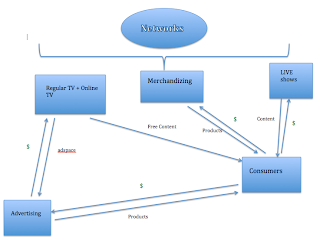
Due to these various factors, the TV industry will have to change their model to adapt to the economic and technological shifts. One such way that they can do this is to add a "merchandising" aspect to this model, where they could sell small artifacts such as coffee mugs or t-shirts that feature the TV shows. They could also have "live shows" that audience can buy tickets for. For example, if there is a show like Glee or American Idol, they could have live concerts featured by the artists in the respective shows. They could also have ticket shows for talk shows or other reality shows for which the audience would pay the extra $ to see the artists outside of their TV screens. Therefore, as illustrated in the diagram below, the TV industry will have to move beyond the 3-party model to accommodate to the changes in the industry.
Video Game Industry
Unlike the other industries we have discussed in class, the video game industry has maintained considerable growth by tapping into new and re-articulated media forms. Whether it be through a traditional console, the internet, or mobile device, the video game industry has been able to commodify the consumers experience. The primary revenue streams that support this model are through in-store sales, digital subscriptions and advertising placement. A major threat that is posed to this this model is the greater influx of social media and mobile application platforms offering games/services for free. However, that harm is mitigated for those companies by offering advertisement space much like the three-party model of network television.
However, the traditional business model of high cost barriers of entry for creation and distribution associated with the industry is reworking itself in order to adapt to such changes. First, video creators are looking to merge pre-existing media forms with their technology in order to garner a competitive advantage. This is demonstrated by Mötley Crüe who released their new single in 2008 on iTunes and the "Rock Band" platform; sales on "Rock Band" outweighed iTunes 5:1 according to Billboard. Moreover, the mergers of not only content but businesses has allowed many new technologies to emerge and become vertically integrated within the industry (Example: Activision & Vivendi). What is also interesting is the shift to a non-cyclical business model for many companies as the virtual reality created by video games becomes more and more life-like that the habitual attitude and competitive nature of playing requires daily use.
As I see the industry, the commodification of the experience will most likely make a greater shift where activities performed in these virtual worlds will produce rewards in the physical world. I would suggest that brands and consumer products utilize the mobile geo-location capabilities and the fanatic fandom of video game platforms to reward customer loyalty by awarding gifts or coupons within the virtual space that can be redeemed in real-life. This has been done for many of the female video games and big brands such as Procter and Gamble available for fashion and cultural purposes but I foresee an even greater profit margin to be made when brands can find greater synergy between the virtual and real worlds by using virtual distribution in order to lower costs in the front end.
However, the traditional business model of high cost barriers of entry for creation and distribution associated with the industry is reworking itself in order to adapt to such changes. First, video creators are looking to merge pre-existing media forms with their technology in order to garner a competitive advantage. This is demonstrated by Mötley Crüe who released their new single in 2008 on iTunes and the "Rock Band" platform; sales on "Rock Band" outweighed iTunes 5:1 according to Billboard. Moreover, the mergers of not only content but businesses has allowed many new technologies to emerge and become vertically integrated within the industry (Example: Activision & Vivendi). What is also interesting is the shift to a non-cyclical business model for many companies as the virtual reality created by video games becomes more and more life-like that the habitual attitude and competitive nature of playing requires daily use.
As I see the industry, the commodification of the experience will most likely make a greater shift where activities performed in these virtual worlds will produce rewards in the physical world. I would suggest that brands and consumer products utilize the mobile geo-location capabilities and the fanatic fandom of video game platforms to reward customer loyalty by awarding gifts or coupons within the virtual space that can be redeemed in real-life. This has been done for many of the female video games and big brands such as Procter and Gamble available for fashion and cultural purposes but I foresee an even greater profit margin to be made when brands can find greater synergy between the virtual and real worlds by using virtual distribution in order to lower costs in the front end.
Digital Distribution

Where we used to go to the movies and sit in the theater, we now have a new and different way to experience a movie. This is what we call Digital Distribution. Digital distribution has been difficult for filmmakers because they now must deal with the "free versus pay" issue, which often is more complicated by online piracy. There are some digital distributors out there who believe that economics of the film industry has been completely threatened, and may never come back from it. Netflix, for example, has recently said that they are going to be focusing more on having a vast amount of TV shows. They believe that the real money lies in the television shows because it enables audiences to watch one show after another. Through subscriptions and things like Netflix, the movie industry may be on a slow decline.
However, sometimes the new way of distribution has helped certain people within the Film Industry. For example, Passion Films was shocked when they saw how many times their movie "Inside Iraq: Untold Stories" had been illegally uploaded. However, they gained a very high audience through digital media as well. By being free online, the buzz around the film increased its DVD revenues when people could no longer see it online.
Because of the rise in digital technology, most movie studios are moving to replace film and move toward smaller projects. This would mean lower costs, and the change in content would be seen in the rise of more sequels and franchises. Most film industries are changing into companies that try to reach its audiences in different ways in order to drive revenue, and the content change is their way to do that.
If I were an executive in the Film Industry, it would definitely be extremely difficult to adapt to the new economic shifts within the industry. While online piracy is a shame, it is impossible to avoid. With the increasing advancements in technology, the way we watch movies is going to continue to change. The fact of the matter is people don't want to go to the movies as much as they used to, and instead they would rather be in the comfort of their homes than paying $10 to see a movie they are unsure of. I would suggest doing MORE online subscriptions, and creating a Netflix-type place for each studio. If Universal had an online subscription, once the movie is released, people would be able to pay a certain amount to be able to see that movie for free. It is hard to say if this would work, but I think that the studios could make money off of advertising in this way, while proving lower costs for the movie theaters.
Youtube Video:
The Future of the Film Industry
Other Related Articles:
http://bzfilm.com/articles-notes/u-s-movie-industry-hurt-with-poor-distribution-logistics/
http://bzfilm.com/tips-sources/film-financing-in-hollywood-past-and-present/past-and-present/
Subscribe to:
Posts (Atom)