Showing posts with label production. Show all posts

Monday, March 19, 2012

The Emotion Work of Reality Television


Television producers of reality shows are responsible for guaranteeing that over the course of filming there will be dramatic and emotional encounters to become the core of an on-screen story. Grindstaff says that the normal route of manipulated situations to create a more stressful interaction is problematic because there are limits as to what contestants would be willing to do and they always have the ability to quit during production. Instead, producers must create an emotional connection and build a relationship with each guest or contestant on their show.

 Grindstaff explains that, in general, most females and men in lower economic classes use ‘emotion work’ – meaning they use emotions to not only build relationships but also provoke desired reactions from their peers. These slight manipulations are often used to maintain normalcy, but can be used by producers to inspire more emotionally charged reactions from individuals on reality or talk shows.

Personally, I am unsure how necessary this tool of emotional manipulation is. I believe it is important for producers to build good relationships with the contestants so that everyone feels comfortable during the filming process, but I do believe that the situations themselves create high levels of stress and therefore heated reactions from the contestants. However, in a talk show or a confessional situation, it is important for the producers to know how to bring down emotional walls. By this point, the participants will have emotional guards in place about what is being discussed and producers have to build a trusting relationship to break through.

While I do believe these types of relationships are useful in creating dramatic reality television, I wonder how ethical they are. Contestants know to question the tasks they are assigned and their fellow competitors when they agree to appear on a reality how. However, most do not think to question the production staff of the show – the producers are supposed to be on their side. While I do feel somewhat uneasy about the imbalanced relationship if contestants are aware of their situation and lack of power, and producers do not overly abuse it these emotional connections help create good reality television.


Questions:
-How do producers approach the participants of a reality-competition show differently than an average reality show?

-Is the main goal in creating a show always to create the most dramatic story or is there a benefit to creating a simpler and more realistic plot line?

-How much do contestants personalities versus talent influence their ability to join or remain on a reality-competition show?

Monday, February 27, 2012

Creative versus Corporate: a shift towards economic efficiency


            Roberts invokes these two identities during the key biases and gaps in the current body of research.  He distinguishes that in this clash it is really the executives that stifle the creative process of television and movies by keeping control over the production and distribution of these platforms.  It is not suprising to find out that there is a clash between the creative and commercial sides of the business.  This seems to be a trend in any sort of business that has a creative aspect to it.  Artists constantly claim to be stifled by commercial or business motives.  It is interesting, however, that Robert’s notes that creative writers go through the internal process of assessing whether something will be able to be a commercial success if it is picked up.  The internal dialogue of executives is much more business focused: “Can we sell it, is it marketable, is it even good.”  The question of is it even that good is basically a secondary question after executives figure out if they can even sell and market the movie.
            It seems through Robert’s research that the creative side is not as slighted as one might initially think.  Through his research there were opinions that were pulled showing that writters were actually shrude businessmen in their conduct over rights and royalties.  It is interesting to note that in today’s climate everyone understands the value of making a buck and therefore both creative and executives do what is nessecary to squeeze as much money out of a production as possible.  It seems that while there is a creative/commercial struggle that still drives some of Hollywood/broadcasting, the culture is very risk averse due to the large price tags of productions.  I think that now in this enormous industry that both creative and executives are adjusting their practices to be the most economically efficient, instead of argue of creative rights.  I think this is why some of the only artistically driven movies that become commercial have to have success at major film festivals before they are picked up by big studious, and that this is the reason for much of the blandness that surrounds the movie and television industry.

Friday, February 24, 2012

The Cost of Planning: Financing of Film


While it seems obvious to most that huge amounts of money is invested into the production and distribution of films, many do not think about the amount of time and money it takes to plan movies, and a large majority of them will never make it to production.

Before a script is written, contracts involving ownership rights and royalties will have to be created for movies based on another piece of work. This means that fees are paid before anyone even knows if a quality piece of work will be created. Also, this is just one step during the planning of a film where entertainment lawyers will be hired. The screenwriters themselves do not typically make a large sum of money and are uncertain if their products will ever sell, but a few are able to create contracts with studios to create scripts for specific movie ideas. In addition to hiring writers, a producer or director may be paid in advance for a specific film in a development deal.

Agents and managers receive their fees during the planning phase; both represent their clients and secure their involvement in a film but there are some key differences. Agents may help plan product placement in a film, because they represent writers who can involve products early on, they have an interest in future versions of the product, and they generally receive 10 percent of their client’s payment. Managers are able to develop and produce media and they receive 15 percent of their client’s payment.

Once a producer is hired, and a movie is green-lighted, the organization for the production begins. A producer will have to find locations for filming, rent studio space, hire a crew, and secure equipment to be used to production. Personally, I thought this was the most surprising cost, because I never thought about the expense of equipment and the fact that studios themselves may not take on this financial liability - due to the high cost of cameras and other equipment, most films will rent these products. There is a huge amount of money spent through every step of creating a movie, from planning and overhead to production and distribution, most of which is not obvious to the audience.

Thursday, February 23, 2012

Pacts: Hinder, Help, or just Convenience

Pacts are agreements between production companies and studios for development and output of (in this case) film.  These production agreements lead to continuous film production between studios and companies and have a positive correlation with box office success.  The production pacts speed up the production process; take Wasko's example of Michael Crichton's story and Fox studios.  The process was shortened because Fox was the only company the book was sold to instead of having it shopped around.

So why the big deal?  Why does it matter if all production pacts do is speed the process up an lead to box office success.  This is true but with production pacts many writers, ideas, and concepts cannot break into the market.  These pacts effect the process because it provides a shortcut for producers and studios, they are cost-effective, and a successful pact has been shown to lead to box office success; the flip side is they are not inclusive they do not provide a lot of opportunity for new ideas and talent to enter on the production side of film.

There is no denying that production pacts regulate and effect the film industry.  They secure success for major companies and are not really helpful to the "little guy."  Regardless of the negatives in concerns to the "little guy" they are economically valuable ways for production companies to continue success.  In any business money is the driving factor; the film industry is no different.  Unfortunately the desire for economic success has a negative effect on the production of texts.

The pact process does not include many "little guy" companies.  It does not provide great opportunities for inclusion and promotes consistency with major name companies.  Who knows how many ideas, concepts, blockbusters, and potential this system has disregarded or left out.  While the system creates convenience for big name production companies it has a negative effect on the production of texts and on "little guy" companies. 


Friday, October 7, 2011

Where does all the money go?

Planning: Is the first phase of costs for individual projects. It begins with securing the script either through the studio, author (of a book) or even a game prototype. This part of the process is extremely risky in terms of money because there is no guarantee at this point that the script will become a movie/television show/ video game. Edward Jay Epstein said, “One out of every ten scripts that studios buy is ever developed into a film” (Havens & Lotz).

While the procedures alters with each film the process and areas of cost remain about the same.

1. Negotiating film rights and properties to work: making sure individuals creative talent is preserved and correctly acknowledge/rewarded

2. Important People

a. Writers: Either hired by the studio or the directors or producers. It takes multiple steps to reach the final product (which even then can be changed during production).

b. Agents/Agencies/Managers: Often hired by writers and other important “players” to represent them and be in charge of marketing their different products and help negotiate terms that are favorable for the individual.

c. Entertainment Lawyers: help to organize and navigate through the different terms and contracts. They are especially useful for motion picture productions.

d. Producers: There are many different types of produces and spread across a wide range of roles. Typically they guide a film through development (obtaining a scripts, selecting talents, securing financing), pre-production, production, and post-production.

3. Production companies: Form pacts and agreements for development and output – ultimately deciding which network or studios will have the rights to which film. Not all pacts involve financing upfront but some do (ex: a first-look deal).

4. Key Talents (actors/actresses): a large part of the budget, especially depending on their previous work and fame, goes to the actors and actresses.

5. Funding sources: This plays a huge role in whether the film moves to production. There are so many aspects in this step that can fall and ruin the films chance at being produced. This is when they seek out loans, investments, advertisements, product placement deals, etc

6. Co-Production: the “creative partners” – this relationship helps with the funding in return receiving rights to the final film/show

7. Pre-Production Costs: this includes the filming materials and other equipments (which is usually rented)

8. Location: this has moved from primarily set designs in California to the new phenomenon of having sets “on location”. These various locations love the business and press that their spot gets so they become very accommodating for production companies and studios.

9. Post Production: Special effects (which keep needing to top the last movie), editing, scoring, music, and the cost just seem to continue even after all the filming is over.

The costs that surprised me the most were the ones towards the beginning, which involved all the legal aspects and the partnerships/pacts with different companies. All of these hidden costs happen before the actors and actresses are even casted, before the film is even produced and then on top of everything the companies need to invest more in advertising and marketing. By the time the film is finalized these companies are in so much debt and yet still don’t know if the audience will like the final product or not. The whole process was extremely interesting to see lay out in this article. As viewers we only see the final product and have no idea what time, money, and manpower need to go into making the 2-hour film we pay (or at least should pay – a whole other cost issue) to see.

Any Respect for the Writers?


Wasko’s article describes the process behind how the film industry works. The process begins with the writers, who, more often than not, are adapting someone else’s original idea into a new movie (there seem to be even less original ideas over the past decade than ever before). The writers hold minimal power because they are not often the reason that movies are popular; instead it is on the rest of the industry to get the right pieces in place: the studio must hire the right producers, who in turn are tasked with finding a marketable cast (or in some cases one huge star) and finding a director who will take the written screenplay and turn it into film, and all of these parties must work with the agencies (or management companies) that represent said parties. Thrown into this mix as well are the entertainment lawyers, who generally keep order of the entire business. The film must also be under budget and marketable to a large enough audience to warrant a theater release. After all of this work, it is incredible that as many films get produced as they do now, especially considering that over 85% of scripts end up in development hell (the name is pretty self explanatory).

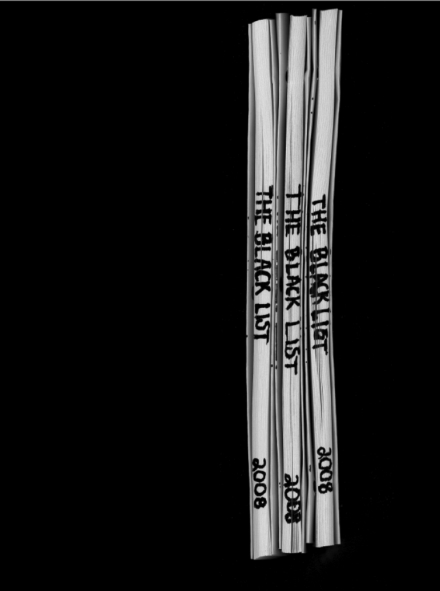
In this model, I often find myself sympathizing with the writers, as they often hold the key to creating original films, and then they find themselves stuck in the business because of their low standing on the totem pole and how easily they can be pushed out of the picture after they write a film and sell it to a studio. Even if the film is made, and the odds are very much against that, they do not receive the acclaim that the director and the stars get (one could argue that they also get less of the blame, but the writers are generally so anonymous it doesn’t matter). One of the coolest sites I found over the last year is “The Blacklist” a document that lists the most “liked” scripts over the past year that have not been made into films. The list is formed by hundreds of film executives, and provides a short synopsis of dozens of scripts. Eventually, some of these scripts get made into movies (2008’s list includes Inglorious Basterds, Sherlock Holmes, and I’m with Cancer, which was recently released last week under its new title 50/50). It’s pretty cool to see all these scripts and see familiar movies, flops and hits alike, as well as seeing scripts that might never be made.


Friday, September 9, 2011

Upfront about Upfront's

“The Promotional role of Network Upfront Presentations in the Production of Culture” by Amanda Lotz examines network Upfront presentations, specifically the processes broadcasters use to sell themselves and their audience to advertisers and the ways in which these promotional activities affect the landscape of commercial TV, and thus, culture at large. Lotz describes these ritualistic, commercially important, and very expensive Upfront presentations as a means for broadcasters to strategically assert their primacy within the industry, control and construct a network identity that appeals to particular demographics, as well as sell 75%-95% of their primetime ad space within a week of their presentations. The important take away from the perspective of a communication scholar is the articulation of real world broadcasting culture in which broadcasters seek to “sell audiences” to advertisers rather than “programming to viewers”. This is evidenced by the strategies employed by broadcasters in determining programming content, which centers around the creation of a “network brand” through the broadcasting of shows that fit that brand, and thusly creates a distinct “network audience” with network identity and loyalty. For example, the WB strategically created a “network brand” that appeals to younger adults and teens, a demographic they believed to be untapped by broadcasters as well as advertisers at the time. To appeal to advertisers wishing to connect with the younger audiences, the WB produced and broadcasted shows that would interest this demographic and subsequently generate an increase in ad revenue. It is in this way that the process of selling audiences influences and determines media content, and in turn shapes culture and society. Today, television has become so pervasive and omnipresent its effect on culture is undeniable. I believe that Lotz would further argue, that advertisers ability to affect the programming decisions made by broadcasters, gives them keys to a lock they should not be privy to. I tend to agree, when advertisers in the American media industry have the power to make a show a cultural icon, or a show that only lasts a two episode, the audience is hurt.