After reading through Roberts and the Articles, "The Day Movies Died" and "Sequels come Fast and Furious as Studios Aim to Cut Risk," It is very evident in my mind that their is now a gap between the Creative and Commercial aspects of making a successful movie or even TV show. In the modern era that we live in people expect more and more from the movies that they go see. The issue with this is that these expectations cost a lot of money in terms of what it takes for the producers to make them. If these shows or movies flop there is a large amount of loss and sunk costs in regards to this risk.
It is my opinion that although yes there has been an increased amount of communication between Creative and Commercial, as Rogers says, the industry is clearly dominated by the commercial risks. Anymore we see studios fighting battles over who can get the rights to popular books, especially those that come in a multiple part series. The people in the Commercial sectors can be almost sure that because of PREVIOUS success, these movies will be profitable. This is the point when it seems Creative gets involved, but it is still not until after the fact when the people in charge of Commercial aspects have made up their mind about what needs to be created.
Although it is a shame that it seems some creative aspects have been extracted out of Hollywood, people have to remember that it is still essentially a business. If movies or TV Shows flop, people lose their jobs and sometimes studios will have to go bankrupt. Two of the best examples I can think of personally in recent history would have to be the Harry Potter movie series and the Toy Story Series. Both were done a little differently in terms of timing and release but in both cases the hype and popularity for each case almost created as some business men say are their two favorite words, "sure thing." I argue that commercial does have a say over creative at the moment, and if you dont believe me, here is one of the most hyped upcoming movies...
Showing posts with label Hollywood. Show all posts
Showing posts with label Hollywood. Show all posts
Monday, February 27, 2012


Thursday, February 23, 2012
Pacts: Hinder, Help, or just Convenience
Pacts are agreements between production companies and studios for development and output of (in this case) film. These production agreements lead to continuous film production between studios and companies and have a positive correlation with box office success. The production pacts speed up the production process; take Wasko's example of Michael Crichton's story and Fox studios. The process was shortened because Fox was the only company the book was sold to instead of having it shopped around.
So why the big deal? Why does it matter if all production pacts do is speed the process up an lead to box office success. This is true but with production pacts many writers, ideas, and concepts cannot break into the market. These pacts effect the process because it provides a shortcut for producers and studios, they are cost-effective, and a successful pact has been shown to lead to box office success; the flip side is they are not inclusive they do not provide a lot of opportunity for new ideas and talent to enter on the production side of film.
There is no denying that production pacts regulate and effect the film industry. They secure success for major companies and are not really helpful to the "little guy." Regardless of the negatives in concerns to the "little guy" they are economically valuable ways for production companies to continue success. In any business money is the driving factor; the film industry is no different. Unfortunately the desire for economic success has a negative effect on the production of texts.
The pact process does not include many "little guy" companies. It does not provide great opportunities for inclusion and promotes consistency with major name companies. Who knows how many ideas, concepts, blockbusters, and potential this system has disregarded or left out. While the system creates convenience for big name production companies it has a negative effect on the production of texts and on "little guy" companies.
So why the big deal? Why does it matter if all production pacts do is speed the process up an lead to box office success. This is true but with production pacts many writers, ideas, and concepts cannot break into the market. These pacts effect the process because it provides a shortcut for producers and studios, they are cost-effective, and a successful pact has been shown to lead to box office success; the flip side is they are not inclusive they do not provide a lot of opportunity for new ideas and talent to enter on the production side of film.
There is no denying that production pacts regulate and effect the film industry. They secure success for major companies and are not really helpful to the "little guy." Regardless of the negatives in concerns to the "little guy" they are economically valuable ways for production companies to continue success. In any business money is the driving factor; the film industry is no different. Unfortunately the desire for economic success has a negative effect on the production of texts.
The pact process does not include many "little guy" companies. It does not provide great opportunities for inclusion and promotes consistency with major name companies. Who knows how many ideas, concepts, blockbusters, and potential this system has disregarded or left out. While the system creates convenience for big name production companies it has a negative effect on the production of texts and on "little guy" companies.
Monday, October 31, 2011
The Film Industry: Choice, But Not Much Choice

In our discussion of Drake’s article about distribution and marketing, one point in particular makes Hollywood a unique industry: “films are product-differentiated in more complex ways than other categories of products (64)”. This fact is very interesting, especially when considering the number of options that are available at any given time in theaters. However, part of the film industry’s success is that while it gives cinemagoers various options for genres, it does not give them much choice across these genres. Unlike television, where there are now so many specialized networks that produce shows to very specific audiences due to the rise of cable networks, moviegoers are limited to one or maybe two films that fit the genres which they want to see. Speaking from a personal standpoint, I usually only go to the theater to see a comedy movie, and I am picky about what comedy movies I want to see, so I rarely go to the theater (I haven’t been to theaters since Horrible Bosses, and I won’t be back until I go see the new Harold and Kumar).
This model sets up a unique situation for people that go to the theater; sometimes it is not an issue of seeing a particular movie, but instead it becomes an issue of what would be the best movie based on a particular genre. A great example of this occurred this past weekend; it was Halloween and amazingly the only scary movie with a wide release was Paranormal Activity 3, so if one wanted to see a scary movie this past weekend, there was one option. This creates an interesting problem for the consumer: do you go to the theater to see a movie because it is in a certain genre, or do you not go because you don’t care about the particular film. In addition to this personal problem, because going to the movie theater is a group activity, the opinions of what others want to see must also be factored in to movie selection. Going back to Drake’s point, just about every film is different than their counterparts, but because options within genre are limited in theaters, the consumer’s choice often comes down to whether or not they have the money or will to see a movie, with the quality of the film being secondary in most cases. This could be one reason why Oscar winning films are not widely viewed in theaters and why the blockbuster film is a critical business tactic for Hollywood studios.
Friday, October 7, 2011
Any Respect for the Writers?
Wasko’s article describes the process behind how the film industry works. The process begins with the writers, who, more often than not, are adapting someone else’s original idea into a new movie (there seem to be even less original ideas over the past decade than ever before). The writers hold minimal power because they are not often the reason that movies are popular; instead it is on the rest of the industry to get the right pieces in place: the studio must hire the right producers, who in turn are tasked with finding a marketable cast (or in some cases one huge star) and finding a director who will take the written screenplay and turn it into film, and all of these parties must work with the agencies (or management companies) that represent said parties. Thrown into this mix as well are the entertainment lawyers, who generally keep order of the entire business. The film must also be under budget and marketable to a large enough audience to warrant a theater release. After all of this work, it is incredible that as many films get produced as they do now, especially considering that over 85% of scripts end up in development hell (the name is pretty self explanatory).
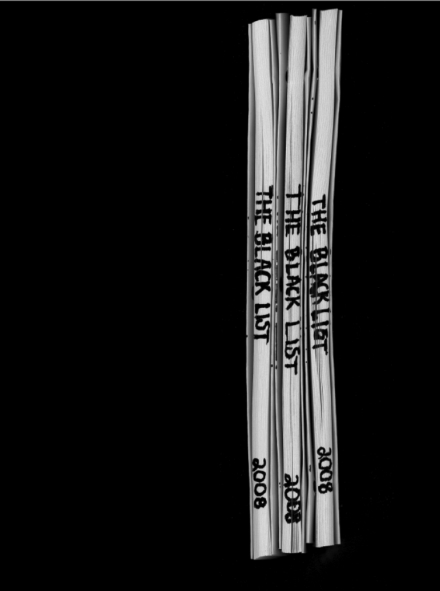
In this model, I often find myself sympathizing with the writers, as they often hold the key to creating original films, and then they find themselves stuck in the business because of their low standing on the totem pole and how easily they can be pushed out of the picture after they write a film and sell it to a studio. Even if the film is made, and the odds are very much against that, they do not receive the acclaim that the director and the stars get (one could argue that they also get less of the blame, but the writers are generally so anonymous it doesn’t matter). One of the coolest sites I found over the last year is “The Blacklist” a document that lists the most “liked” scripts over the past year that have not been made into films. The list is formed by hundreds of film executives, and provides a short synopsis of dozens of scripts. Eventually, some of these scripts get made into movies (2008’s list includes Inglorious Basterds, Sherlock Holmes, and I’m with Cancer, which was recently released last week under its new title 50/50). It’s pretty cool to see all these scripts and see familiar movies, flops and hits alike, as well as seeing scripts that might never be made.
Wednesday, August 31, 2011
What Netflix Could Teach Hollywood
The article I read explains that Hollywood chooses movies to promote that they feel will be aimed at the majority. A common misconception is that of the 6o,000 titles available on Netflix only 1,000 are rented a day. This is far from the truth, Netflix calculated that 35,000 to 40,000 movies are rented from the selection each day. The article goes on to explain that while Hollywood only promotes certain movies, audiences are looking for a wider selection to view. With Netflix's ability to house over 60,000 titles it proved to be far more effective then video stores who were limited to how many movies could be shelved.
While Netflix is still evolving and making improvements to help please their critics, it has proven to be an important step forward in the media industry. No longer will movies be forgotten or eliminated because of Netflix!
Subscribe to:
Posts (Atom)