According to the annual State of News Media journalism report, magazine revenue have been declining tremendously since 2007. Magazines rely heavily on advertisements but with growth in technology, the fate of ads in magazines is uncertain. I think its important to focus on how and what ideas magazine companies have been coming up with to increase revenue on how to get consumers to buy the magazine, which will piggyback new revenue stream idea for ads in magazines.
In a blog written by Amanda Lucci, New York Mag Picks New Revenue Stream, she explains that magazine companies like the New York Magazine have decided to move the classified sections from the back of the magazine to the front, therefore people will be able to see opportunities they could participate in as soon as they open a magazine. This idea was incorporated by placing dating websites in the front of the magazine, which promoted a growth in the dating website being advertised. Another idea that has been added to pick up revenue stream for print magazine is creating DVD's with archives of magazines from years ago. The article, Repurposing Magazines A New Revenue Stream, explains two magazines that are in the process of being transformed, which include Playboy and Rolling Stone. These two ideas for creating more revenue in the magazine industry are not the only ideas but have caused great shifts in the content of what magazines produce. Magazine companies are now requiring to hire a web designer and a good publisher to work together to create both print and digital apps, according to an article published in Forbes.
The future of magazines looks a bit grim but to increase the revenue stream, I believe magazines should package their products differently. In other words, I think a way to boost revenue is to put a code on the back of every magazine to type into your electronics where you then can download a free copy of that issue you just bought, therefore you have a digital copy and a hard copy. What happens if someone decides to buy a digital copy instead? Well, the same option is presented to the consumer you will pay the same price you would at the store and the magazine will be sent to you in the mail. This could be one way magazines could increase their stream of revenue.
Monday, March 5, 2012


TV industry in the digital age
Broadcast television relies primarily on advertising for its revenue stream. However, with technological advances in the television industry, this revenue channel is being threatened as more and more people are beginning to adopt alternative means of consuming TV. However, broadcast television has seen ad revenues decline at an increasing rate. Primary threat to ad revenue comes from various media options available to the consumers. Online TV is becoming increasingly popular, as TV audience no longer has to follow the broadcast TV schedule, and watch the TV content on their portable device. Moreover, to add to that, digitalization of the industry has not only made piracy easy, but pirated contents are also fairly easy to find today. Shifting to this form of TV has allowed consumers to enjoy television content without any advertisement disruptions. In addition, things like Google TV that provides free access to content only intensifies the challenges for broadcast television. DVRs are another means through which broadcast television ads are being threatened while giving more power to the consumers. More ad-free media technology such as Netflix and iTunes are also hampering the broadcast television business.
Due to various factors, broadcasters have had to adopt alternative means to continue a profitable business. Retransmission fees is one such way that they have tried to do this so that broadcast television can take advantage of the cable operators and try to gain back some of the loss in ad revenues. Moreover, with the technological advances, interactive tv has also become increasingly popular. Through this, broadcast television can try to get some of the advertisement revenues on this “second screen” that consumers are increasing along with their traditional television. Another way they can adopt to the change in this industry is by integrating advertisements within the show that won’t disrupt the viewers. They will also need to look for additional platforms to provide reruns of their show so that they can make up some of the loss in revenue. Time warner has embraced this idea of “TV everywhere to adapt to the economic threats provided by the loss in ad revenues.
These economic shifts have also impacted the content in this industry. Because content producers now have to compete with the free content available online, their incentive for creative content has been decreasing. Because, their profit is being challenged, they have to avoid taking excessive risks, thereby playing safe, often compromising creativity. In addition, this has also led to an even more “consumerism” within television. Farrell illustrates how branded entertainment and branded content are being integrated in the television industry these days.
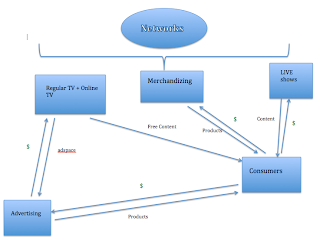
Due to these various factors, the TV industry will have to change their model to adapt to the economic and technological shifts. One such way that they can do this is to add a "merchandising" aspect to this model, where they could sell small artifacts such as coffee mugs or t-shirts that feature the TV shows. They could also have "live shows" that audience can buy tickets for. For example, if there is a show like Glee or American Idol, they could have live concerts featured by the artists in the respective shows. They could also have ticket shows for talk shows or other reality shows for which the audience would pay the extra $ to see the artists outside of their TV screens. Therefore, as illustrated in the diagram below, the TV industry will have to move beyond the 3-party model to accommodate to the changes in the industry.
Video Game Industry
Unlike the other industries we have discussed in class, the video game industry has maintained considerable growth by tapping into new and re-articulated media forms. Whether it be through a traditional console, the internet, or mobile device, the video game industry has been able to commodify the consumers experience. The primary revenue streams that support this model are through in-store sales, digital subscriptions and advertising placement. A major threat that is posed to this this model is the greater influx of social media and mobile application platforms offering games/services for free. However, that harm is mitigated for those companies by offering advertisement space much like the three-party model of network television.
However, the traditional business model of high cost barriers of entry for creation and distribution associated with the industry is reworking itself in order to adapt to such changes. First, video creators are looking to merge pre-existing media forms with their technology in order to garner a competitive advantage. This is demonstrated by Mötley Crüe who released their new single in 2008 on iTunes and the "Rock Band" platform; sales on "Rock Band" outweighed iTunes 5:1 according to Billboard. Moreover, the mergers of not only content but businesses has allowed many new technologies to emerge and become vertically integrated within the industry (Example: Activision & Vivendi). What is also interesting is the shift to a non-cyclical business model for many companies as the virtual reality created by video games becomes more and more life-like that the habitual attitude and competitive nature of playing requires daily use.
As I see the industry, the commodification of the experience will most likely make a greater shift where activities performed in these virtual worlds will produce rewards in the physical world. I would suggest that brands and consumer products utilize the mobile geo-location capabilities and the fanatic fandom of video game platforms to reward customer loyalty by awarding gifts or coupons within the virtual space that can be redeemed in real-life. This has been done for many of the female video games and big brands such as Procter and Gamble available for fashion and cultural purposes but I foresee an even greater profit margin to be made when brands can find greater synergy between the virtual and real worlds by using virtual distribution in order to lower costs in the front end.
However, the traditional business model of high cost barriers of entry for creation and distribution associated with the industry is reworking itself in order to adapt to such changes. First, video creators are looking to merge pre-existing media forms with their technology in order to garner a competitive advantage. This is demonstrated by Mötley Crüe who released their new single in 2008 on iTunes and the "Rock Band" platform; sales on "Rock Band" outweighed iTunes 5:1 according to Billboard. Moreover, the mergers of not only content but businesses has allowed many new technologies to emerge and become vertically integrated within the industry (Example: Activision & Vivendi). What is also interesting is the shift to a non-cyclical business model for many companies as the virtual reality created by video games becomes more and more life-like that the habitual attitude and competitive nature of playing requires daily use.
As I see the industry, the commodification of the experience will most likely make a greater shift where activities performed in these virtual worlds will produce rewards in the physical world. I would suggest that brands and consumer products utilize the mobile geo-location capabilities and the fanatic fandom of video game platforms to reward customer loyalty by awarding gifts or coupons within the virtual space that can be redeemed in real-life. This has been done for many of the female video games and big brands such as Procter and Gamble available for fashion and cultural purposes but I foresee an even greater profit margin to be made when brands can find greater synergy between the virtual and real worlds by using virtual distribution in order to lower costs in the front end.
Digital Distribution

Where we used to go to the movies and sit in the theater, we now have a new and different way to experience a movie. This is what we call Digital Distribution. Digital distribution has been difficult for filmmakers because they now must deal with the "free versus pay" issue, which often is more complicated by online piracy. There are some digital distributors out there who believe that economics of the film industry has been completely threatened, and may never come back from it. Netflix, for example, has recently said that they are going to be focusing more on having a vast amount of TV shows. They believe that the real money lies in the television shows because it enables audiences to watch one show after another. Through subscriptions and things like Netflix, the movie industry may be on a slow decline.
However, sometimes the new way of distribution has helped certain people within the Film Industry. For example, Passion Films was shocked when they saw how many times their movie "Inside Iraq: Untold Stories" had been illegally uploaded. However, they gained a very high audience through digital media as well. By being free online, the buzz around the film increased its DVD revenues when people could no longer see it online.
Because of the rise in digital technology, most movie studios are moving to replace film and move toward smaller projects. This would mean lower costs, and the change in content would be seen in the rise of more sequels and franchises. Most film industries are changing into companies that try to reach its audiences in different ways in order to drive revenue, and the content change is their way to do that.
If I were an executive in the Film Industry, it would definitely be extremely difficult to adapt to the new economic shifts within the industry. While online piracy is a shame, it is impossible to avoid. With the increasing advancements in technology, the way we watch movies is going to continue to change. The fact of the matter is people don't want to go to the movies as much as they used to, and instead they would rather be in the comfort of their homes than paying $10 to see a movie they are unsure of. I would suggest doing MORE online subscriptions, and creating a Netflix-type place for each studio. If Universal had an online subscription, once the movie is released, people would be able to pay a certain amount to be able to see that movie for free. It is hard to say if this would work, but I think that the studios could make money off of advertising in this way, while proving lower costs for the movie theaters.
Youtube Video:
The Future of the Film Industry
Other Related Articles:
http://bzfilm.com/articles-notes/u-s-movie-industry-hurt-with-poor-distribution-logistics/
http://bzfilm.com/tips-sources/film-financing-in-hollywood-past-and-present/past-and-present/
Magazine Industry
In 2011, 41.3 % of magazine publishing came from print advertising; however, although print advertising is still the most primal revenue, according to the online article written by Kaufman (2011), she says “Not surprisingly, publishers expect less of their revenue to come from print advertising and more from web advertising or online sponsorships”. Online advertising or online sponsorships have become more important recently because of the emergence and increase of online magazine and publishing thorough apps. From my research, I have discovered that development of technology, specifically the emergence of iPad recently, has changed and influenced on magazine publishing industry enormously. Since iPad and tablet has become more popular, more people start purchasing apps or online magazines recently as Smith (2011) says “Whether on or odd the traditional web browser, many of the revenue-generating ideas are being influenced by a new age of apps”. It is important for the publisher to adapt themselves into this new technology because the more customers have started purchasing magazine online. To fail to this adaptation is a fear for publishers and it is necessary for them to follow with this development of new technology.
One of the adaptations to the emergence of new technology magazine industry has done is, of course, creating their app so that more readers can reach through the app. Now it is their challenge for publishes to maintain the balance between online and print publishing, as Pytlak says, “Our publishing partners are trying to find, for their unique audience, what’s the right combination of print/digital, or what a price points – and what does a subscriber to one or the other, or both, actually have access to “. Some magazines even have chosen as their only digital content option (other than their websites), and it means that the reader has to visit the app store for his or her device (ex. iTunes Store) to download the app, and then likely will purchase the subscription to the magazine’s content though the app (Sivek, 2011). Because of this change, the content of magazine has to make adaption as well and it is becoming more important for the publishers to be familiar with new technology to make their content more appealing to the audience. The author of the article I found (“One Model for the Future of Magazine Publishing Holds Forth in Portland, Maine”) says now it requires for the publisher to be a good developer and also web designer as well and he or she says, “It is telling that in this new world of content production, print is just another “screen,” albeit a privileged one with very high-resolution (but low interactivity)” (2011).
If I were a CEO of magazine publishing company, I would also develop an app of our magazine. Since it is a digital form, it makes it more possible to actual interact with customer. I think it will utilize the customers if we utilize its function of touch-screen for the app so that the digital and print publishing can maintain its balance since their content become different and it attract different customers. For example, I would make it possible to touch on the product in the magazine on the screen, and it will show to the customer which store around him or her has the product with how much of the price now.
How do you make music into money?

It is no secret that the music industry is struggling as of late. With the advent of the digital technology age its entire business model is under serious revision so that the industry can maintain its revenue stream. The revenue that the music labels rely on comes mainly from the copyright contracts that they maintain with artists signed to them. Originally, this also included record sales which started off as 8-Tracks, Vinyl, Cassettes, CDs, and Videos. However, now with digital music as accessible as it, there is much less profit to be made because people have stopped buying CDs, and instead either buy songs separately or download them illegally.
Record labels have responded to this by altering the contracts that they have with artists so that they can optimize their profits. (http://www.freakonomics.com/2011/08/31/the-music-industry-copyright-battle-when-is-owning-more-like-renting/) This is further being threatened by recent legislature with copyrights which is giving back artists their rights to songs after 35 years. Record labels previously were able to make a profit on the distribution and production of different songs that they had the copyright to. So how will they be able to maintain their revenue within the industry? With artists also losing profits, the two need to revise the business plan for each so that they both profit jointly together instead of in ways that cheat one or the other out of profits. The content of the music itself is even being threatened because music labels are looking for the most profitable types of music that will make them the most money in the end. Ultimately, with youtube and iTunes, record labels will need to change their relationship with the artist and what they profit from in terms of the music that is recorded in their studios.
If I was a executive in the music industry, I would focus on the concert and touring industry which seems to be losing steam because of the internet and digital era. People can see their favorite videos and listen to their favorite songs quite literally immediately after they are released. The concert experience is one that shouldn't be lost and is one that does make a lot of money when it is executed properly. I also think that there needs to be a settlement when it comes to copyright because too many artists and record labels lose profits from the illegal downloading that has become so prominent in our digital era.
Sunday, March 4, 2012
Can the Magazine Industry Make the Change?
The print magazine industry has had a very grim last couple
of years with a serious decrease in revenue.
The industries main source of revenue comes from advertising and
distribution sales. eMarketer stated
that, “Overall ad spending on magazines declined 7.1% to $13 billion last year
and will shed another 16.2% this year, bringing the market down to $10.9
billion. We will not see an incremental increase in the market until 2012, when
eMarketer expects a meager 4% rebound” (http://www.minonline.com/news/10535.html). The print magazine industry had to make a
serious change in order to survive the growing age of technology. 
The
industry is being threatened by the 180 degree turn towards the digitalization
of media. The majority of media content
can now be easily accessed online and has made it much more convenient for
consumers to access content whenever they desire. Print is not nearly as accessible and easy for
consumers to obtain now that they have internet access at their finger-tips, be
it a laptop, smartphone, iPad, or e-reader.
Another issue the industry is facing is that although online magazine
versions do not accrue the cost of paper, ink and distribution, they now have
new costs to deal with. Havens and Lotz(2012) explain how many print media sources struggle to develop a profitable internet
strategy. However, at the same,
advertisers have not moved into the online space with fees adequate to support
these new costs or fully compensate for the decrease in readership of the
physical print forms.
Although the transformation from print to digital has been a
struggle for many print magazines, many are continuing to try and break into
the digital world. One method of success
is through the use of ‘Single-Story Sales’ (http://www.pbs.org/mediashift/2011/02/how-the-kindle-made-single-story-sales-a-reality-for-magazines-047.html). With the growth of e-reading on tablets,
smart phones, etc. the emergence of Single-Story sales has been enormously
popular. In addition to this many
magazines now have an app that consumers can download and access available
content whenever they so please. If I
was an executive within this industry I would continue to move full speed ahead
with the digitalization of content.
Personally, I still love having a hard copy of a magazine, but with the
rapid increase in technology and the movements towards sustainability and being
Green, I truly believe the print industry will eventually cease to exist.
Subscribe to:
Posts (Atom)