Broadcast television relies primarily on advertising for its revenue stream. However, with technological advances in the television industry, this revenue channel is being threatened as more and more people are beginning to adopt alternative means of consuming TV. However, broadcast television has seen ad revenues decline at an increasing rate. Primary threat to ad revenue comes from various media options available to the consumers. Online TV is becoming increasingly popular, as TV audience no longer has to follow the broadcast TV schedule, and watch the TV content on their portable device. Moreover, to add to that, digitalization of the industry has not only made piracy easy, but pirated contents are also fairly easy to find today. Shifting to this form of TV has allowed consumers to enjoy television content without any advertisement disruptions. In addition, things like Google TV that provides free access to content only intensifies the challenges for broadcast television. DVRs are another means through which broadcast television ads are being threatened while giving more power to the consumers. More ad-free media technology such as Netflix and iTunes are also hampering the broadcast television business.
Due to various factors, broadcasters have had to adopt alternative means to continue a profitable business. Retransmission fees is one such way that they have tried to do this so that broadcast television can take advantage of the cable operators and try to gain back some of the loss in ad revenues. Moreover, with the technological advances, interactive tv has also become increasingly popular. Through this, broadcast television can try to get some of the advertisement revenues on this “second screen” that consumers are increasing along with their traditional television. Another way they can adopt to the change in this industry is by integrating advertisements within the show that won’t disrupt the viewers. They will also need to look for additional platforms to provide reruns of their show so that they can make up some of the loss in revenue. Time warner has embraced this idea of “TV everywhere to adapt to the economic threats provided by the loss in ad revenues.
These economic shifts have also impacted the content in this industry. Because content producers now have to compete with the free content available online, their incentive for creative content has been decreasing. Because, their profit is being challenged, they have to avoid taking excessive risks, thereby playing safe, often compromising creativity. In addition, this has also led to an even more “consumerism” within television. Farrell illustrates how branded entertainment and branded content are being integrated in the television industry these days.
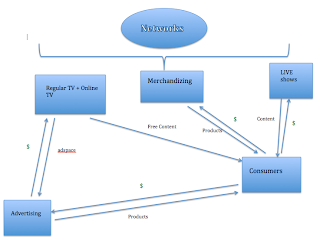
Due to these various factors, the TV industry will have to change their model to adapt to the economic and technological shifts. One such way that they can do this is to add a "merchandising" aspect to this model, where they could sell small artifacts such as coffee mugs or t-shirts that feature the TV shows. They could also have "live shows" that audience can buy tickets for. For example, if there is a show like Glee or American Idol, they could have live concerts featured by the artists in the respective shows. They could also have ticket shows for talk shows or other reality shows for which the audience would pay the extra $ to see the artists outside of their TV screens. Therefore, as illustrated in the diagram below, the TV industry will have to move beyond the 3-party model to accommodate to the changes in the industry.